Our
SNOCRUISE
YAMAHA MOUNTAIN
MAX 600 TWIN
Project
Becomes Our
Prairie JACK 600
|
SNOCRUISE FAMILY TOURS  |
|
SNOCRUISE |
|
SNOCRUISE WINTER WEEKEND POKER DERBY  |


|
SNOCRUISE FAMILY TOURS |
|
SNOCRUISE |
|
SNOCRUISE WINTER WEEKEND POKER DERBY |
|
|
||||
|
2013 YAMAHA MOUNTAIN MAX 600 TWIN PROJECT SLED
This 600 twin is *estimated to have about 3% more HP than the 94 HP version in the 1996 models. This Mountain Max is published to weight about *505 Lbs.. The track is a 136 x 15 with an advertised 1.5" lug. This sled's reasonably short track and all temperature responsive 97 HP mill make it a great trail breaker thru the tight NISBET FOREST trails. *Source winter 96/97 RACE & RALLY magazine. |
||||
|
|
||||
|
|
||||


|
THE ENGINE WAS PARTLY SEIZED |
|
|
|
|
|
Our spare crank was looked after and checked out by The Crank Doctor. |


|
LOOKING
FOR THE CAUSE OF FAILURE |
|
|
|
|
|
|


|
OTHER DAMAGE |
|
|
|


|
CRANKCASE REPAIR and ENGINE ASSEMBLY |
|
|
|
|
|
|
|
|
 The raised edge on gasket surfaces are just dressed with round file to take the riveted ridge surfaces away. |
 The surfaces are cleaned up ready for crank installation.
|
 The crank is in.
|
|
|
 This is the ceramic coating baked on to the skirts. See SIDE BAR: *1 |
|
|
|
 A few marks in the Nicasil from a previous seizure did not hone out but will be forgiving. |
|
|
|
 The last look before the head goes on. |
|


|
SIDE BAR: *1 this baked on ceramic coating on the skirts is designed to make the piston extra slippery resulting in less heat transferred into the water jacket thru the cylinder walls. The thickness is negligible, in fact with a cooler running piston it is likely going to requiring less clearance. The theory being less heat in the piston less expansion. SIDE BAR: *2 The baked on polished reflective quality of the piston top coating is designed to keep more of the heat (read energy) in the combustion chamber where this unspent energy is used to push the piston down, resulting in a greater force, or horse power and torque, and at the same time prevent the piston and wrist pin area from reaching the same high temperatures from repeated firing every stroke and dual compression action on every stroke, like a 2 stroke has. SIDE BAR: *3 The SMART CARB set up was used on Mountain Max 600's from 1996 to 1999. In 2000 the 600 Mountain Max was a triple and did not have SMART CARB. There was however many years of 600 twin Ventures equipped with the SMART CARB. |
|
|
|
|
|


|
ENGINE INSTALL AND FIRE UP |
|
|
|
|
|
|
|
 The primary is equipped with your basic XT/XTC/Venture set up. |
 The secondary has the basic XT/XTC set up. |
 The oil pump was a small hold up. See SIDE BAR *5 soon. |
 The SMART CARB has 2 CDI boxes and lots of wire connections. |
 This is the inlet barometric sensor next to the Ethanol/gasoline switch. |
 They look like your regular Mikuni TM 36 flat sides at a glance. |
 These carbs are officially called Mikuni TM 36 w/TPSx2. |
 Yes the recoil assembly is red, one salvaged XTC for some reason had a lot of hand painted components. |
 The vent line was pressurized, fuel was heard running in thru the needle and seats, she was running on the 2nd pull. |
 We go for an 11 KM test drive at temperatures hovering -5 C (23F) on a nice but a bit windy afternoon. See SIDE BAR: *6 |
 The used plugs that we pulled out of it after 8 or so KM's were actually starting to tan See SIDE BAR: *7 |


|
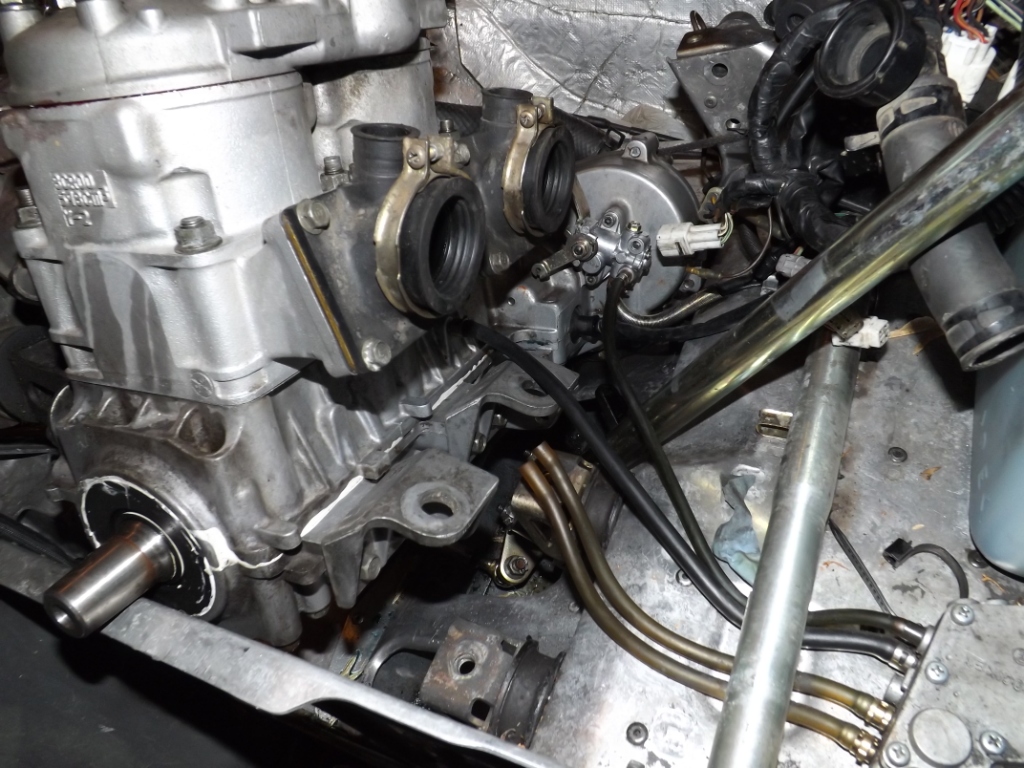
SIDE BAR: *4 This was one of the main hold ups on the whole project. The harmonics (best guess) on the Yamaha 600 twin must play a part in their reliability factor. We have torn down (not exactly the procedure) many 600 twins with broken rods and cranks. Often the resulting damage has actually cut the engine completely into 2 halves. A tear down is not exactly what I would describe, removing the head and tossing the rest in the garbage! We have put 80,000 to 100,000+ Km's on Yamaha 500's without such a failure and they are exactly the same cranks. Sure we have had a couple fuel related engine failures over the last 20+ years, but none were like the catastrophic failure as seen in the 600's we've wrecked for parts. The failures with 500's that we have experienced could be counted on one hand and they were all fuel related except one (** SEE BELOW). In discussion with many factory trained Yamaha mechanics a pattern emerged. This type of failure had not been seen in a well serviced 600 twin that was equipped with electric start. It has been suspected that the addition of the ring gear on the clutch smoothed out the harmonics present. We waited until a ring gear dropped into our lap for our Yamaha 600 twin project. The following snaps are representative of several 600 twins I have salvaged over the years!
SIDE BAR: *6 The sled smoked a fair amount because oil had also been added to the ethanol, but overall the sled ran exceptional for the temperature. She snapped to just a hair under 8000 RPM and hauled to 120KM right now. The sled was responsive and was exceptionally responsive for this temperature. Credit must be given to this 4 year wonder "SMART CARB". SIDE BAR: *7 The used plugs that we pulled out of it after 8 or so KM's were actually starting to tan, the electrode was a bit shiny so the extra oil must be playing a part. I fully expected to see some pretty dark plugs even with the sled running so well. The wait for next winters conditions will be the next step. |
||||||||
|
We get to put this 600 to work with a few more modifications.
|
||||||||
|
So I did out some old scales and check...what does she
weight?
SNOCRUISE TOUR SLEDS Snocruise snowmobile EVOLUTION
|
||||||||
|
||||||||


